
Open Auditions

I once was appointed to a church where the choir had quit.  You laugh.  And I did to. I did so to keep from crying on the Monday morning after my first Sunday of struggling through a service with an empty choir loft, a divided church and recently hired Russian pianist who had taught herself how to play the organ and played every good ole Methodist hymn like a Tchaikovsky ballet.  That first Sunday we sang as our opening hymn the old Methodist standard, Come Thou Fount of Every Blessing, and by the time we were done, the fount and the blessings had been had been drained off into Swan Lake.  We concluded the service with Marching to Zion.  After all, everybody can sing Marching to Zion, right?  Well, not to the tempo of the Dance of the Sugar Plum Fairy.  The entire service was like a pirated version of The Nutcracker and I was the Mouse King who had somehow survived getting stabbed near the end of act one.  I kept replaying over and over the conversation I had with the Superintendent who had failed to mention anything to me about the previous minister’s four year war with the previous choir director. He just kept saying how this church needed effective leadership and how confident he was in my abilities to have an effective ministry there. 

I mean the choir had quit…

They had quit!!!

They had gotten up in the middle of a service, left their robes in their pews and

walked out the door never to sing again!!!!!!!

And here I was trying to lead worship with an empty choir loft and the daughter of Boris Yeltsin’s third cousin twice removed at the keyboard.  Filled with tidings of comfort and joy I was not.  Now to some of you, this may seem like an insignificant detail easily overlooked and even more easily overcome.  After all, it’s just a choir.  It’s just singing a few hymns.   You still have the word.  You still have the sacraments.  You can still pray.  You can still preach.  Well, this is all true.  But, over the course of my ministry, I have learned how important the choir is to worship and how central worship is to being the church. We Protestants are by nature singing people, we Methodists, especially so.  Some of our best theology is contained in our hymns.  Some of our best Christian education and spiritual formation is done through teaching and learning hymns and songs of praise.   And with apologies to our Quaker brothers and sisters, I believe that I am on solid ground when I say that the church is never more truly the church than when our voices are joined together in an act of corporate worship, singing together our praises to God, giving witness to the work of the Spirit in our lives.  Saint Augustine said it best, “Those who sing once, pray twice.”

Well, by October of that first year, we were without an accompanist once again and facing Advent and Christmas without a choir.  We were in the midst of the arduous task of trying to find an organist/choirmaster, only to discover that they were few to be found.  We were just about to give up hope when we received a phone call the Director of Music at another church in town.  He had a man singing in his choir who might be just what we were looking for.  He was a trained organist, a talented musician and looking for a church job.  Now, have you ever forgotten to ask the question?  I forgot to ask the question.  I forgot to ask why such a gifted and talented musician was currently unemployed?  Pastoral words of advice…don’t forget to ask the question. 

We met.  He was a very talented and talkative musician.  He knew his way around the organ and he was very interested in the job. He especially liked the fact that the organ in this church had dual capabilities as a pipe organ and as a digital instrument.  More about that later.  I had some reservations about him, but when he met with the search committee, all they could think about was being able possibly to have a choir on Christmas Eve.    He was hired on the spot and word began to spread through the congregation and the community that there would indeed be a Christmas Eve Choir.   

The first hint of trouble on the horizon was when I saw the announcement for the bulletin on his first Sunday.  It read:  Choir members needed for Christmas Eve Choir. Must be able to both sing and read music.  Auditions begin on Wednesday night. Thankfully, I saw this before the bulletin went to print.  I immediately got him on the phone and helped him to rewrite his announcement.  When it went to print, it read:  Join our Christmas Eve Choir.  Open Auditions.  Everyone Invited.

People responded. In fact, several of the former choir members who had abruptly walked out walked back in just as abruptly.  There was Dorothy (name changed), one of the matriarchs of the church, whose piety masked her pretentiousness.  There was James (name also changed), who had a marvelous tenor voice, but never felt fully appreciated by his family or his church.  And then there was Gerald (again, name changed), whose presence added more tension than talent.  But, after all, we did say open auditions.   Practices were well attended.  All voice parts were covered.  Every pitch was present.  Talent was slim, but spirits were high.  Choir robes were sent out to be dry-cleaned.   It began to look like we would have a choir on Christmas Eve after all. 

When we sat down to go over the service the week prior to Christmas, I knew we were in trouble.   The service was to be a modified Service of Lessons and Carols ending with candle lighting.  Because of the placement of the organ, the director could not direct from the organ.  But, because of the digital capabilities of the organ, the music could be played and the organ could digitally record itself and play what it had recorded with the flip of a switch and a push of a button.  It was the actual organ.  It sounded just like an organist was sitting at the bench.  It was technologically sophisticated, unique and for some, cutting edge.  But for me, it was a disaster waiting to happen.   What if it didn’t work?  What if a power surge made the night truly a silent night?  What if the remote failed?  What if it all fell apart? What if the wrong switch was flipped or the wrong button pushed? I was assured that all would go as planned.  I had my doubts.

Christmas Eve arrived.  The church was packed.  Anticipation was high. The choir loft filled up.  The acolytes entered.  The service began. 

O come, all ye faithful, joyful and triumphant, O come ye, O come ye to Bethlehem.

Come and behold him, born the king of angels, O come let us adore him, Christ the Lord.

We made it through the first hymn, and then through the first anthem.  We sang a few more carols and we listened as the lessons were read.  I was just about to believe that we could actually pull this off, when my worst fears were realized.   The final anthem before we were to light candles and sing Silent Night fell apart.  Someone pushed the wrong button and the organ took on a life of its own.  It began to play songs that were not even in the hymnal.  I will never forget the look on the choir director’s face and the speed with which he got from the choir loft to the organ bench.  I never knew you could move that fast in organ shoes.  He pushed buttons, pulled out stops and did his best to redeem the situation.  But to no avail.  The congregation sat there stunned. Members of the choir dropped their heads in shame.  And the pastor watched his greatest fears unfold right before his very eyes.  It was a liturgical disaster of the utmost proportion.

 I let it go on until the pain was almost unbearable and until I had finished writing out the ad for the new organist/choir director. I stood up and invited the ushers to come forward and instructed them to be prepared to carry the light throughout the congregation.  We would be singing Silent Night with piano accompaniment to conclude the service. Please stand.  And we stood.  The light began to make its way from the Christ Candle throughout the congregation and we began to sing, Silent Night, Holy Night, all is calm and all is bright.

It was almost painful to sing the words.  Calm, tender and mild in no way described this night.  Sleep in heavenly peace I would not. But something happened as we began to sing the second verse.  One of the men began to sing a bit louder than the rest of the choir.  In fact, he was singing louder than the rest of the congregation.  And not on key.  Not even in the ballpark.  I adjusted my stance so I could try and determine who it was.  And as fate would have it, it was Gerald.  Gerald was not the choir member you wanted to feel inspired, especially not on Christmas Eve.  Not only could Gerald not hold a tune in a bucket, Gerald could not find a note if it was gift wrapped with his name printed on it in all capital letters.  Oh how I regretted those open auditions.  We quaked along with the shepherds as Gerald gained confidence with each measure.  His voice stood out and was noticed by all.  But Gerald didn’t care who was listening.  Though off key and even further off pitch, Gerald sang his praises to the God of open auditions and we all followed his lead.  This mere shepherd had somehow heard the real message of Christmas through all the liturgical and technological chaos of the evening.   Gerald sang in the choir not because of his talent, but in spite of it.  And he knew, better than anyone else, that he would have not been there that night but for the fact that there had been open auditions. It was a moment of redemption for him and for us all.  That night, in spite of all that happened, God chose the one with the least talent and the biggest heart to remind us all that God chooses to dwell in us not for what we have to offer, but rather, because all we have to offer is ourselves.  

At Christmas, the God of open auditions comes among us again, asking only for hearts that are open and voices that are willing to join in the heavenly chorus and proclaim to the entire world that because of what happened on that first Christmas long ago, things can be different.  Light can shine into the dark places of our lives.  Hope can be reborn in the stables of our souls.  Forgiveness can find that there is indeed room to dwell. Love can heal the broken places and comfort the broken hearted.  Redemption can be found by both the deserving and the undeserving.  And peace, lasting peace can become not just a tune we hum once a year, but rather a canticle for what can be each day of our lives when God in Christ dwells within us.  Auditions are open.   Who among us is willing to join in and sing?

Gift Exchange

This week we gathered as a staff for our annual Christmas party. The culinary artistry of my colleagues and their spouses was in full form.  It was a wonderful evening of good food, good wine, much laughter and great fellowship –  the embodiment of the phrase live well, laugh often, love much.    We lived and we laughed and we shared our love and respect for one another.  My colleagues are truly gifts to me and I respect them greatly for their commitment to our shared ministry together. 

Part of the evening included a gift exchange.  All the gifts were placed together and numbers were drawn out of a hat.  The first person got to choose a gift and open it.  The next person could either steal the gift or choose another gift to open.  Each successive person could then steal or choose their own.  No gift could be stolen more than two times.  There were some very nice gifts and a few white elephants.  LSU memorabilia abounded.  As the night went on, the competition grew fierce and the collegial bantering got intense, especially when six LSU Men’s Basketball tickets were unwrapped.  I did my share of wheeling and dealing, leaving with a nice LSU Tiger coffee mug and bowl.   But more than leaving with the “gift” I wanted, I left having received friendship, laughter and love.   And I had the chance to share them as well.   They were the true gifts exchanged that night.  And no one had to steal to get them!

Invictus

Invictus

Latin, meaning: 1. unconquered, undefeated.

Today, Julie and I went to see Invictus, the movie that tells the story of the South African Rugby Team’s victory in the 1995 World Cup.   Directed by Clint Eastwood and starring Morgan Freeman and Matt Damon, it was simply outstanding.  Having had the privilege of visiting South Africa in 2005, I was taken back to the streets of Johannesburg, the dusty roads of the outlying townships and beauty of the countryside.  I was also reminded of the power of forgiveness, the need for reconciliation and the truly remarkable events that unfolded following the release of Nelson Mandela from prison and his election as President of South Africa.   I also became intrigued by this strange, but exciting game of rugby.

Mandela discovers early the role that rugby could play a significant role in uniting the country.  South Africa’s National Rugby Team, the Springboks, are scheduled to compete in the 1995 World Cup.  They are in the eyes of most people a dismal failure with no chance of winning.  In many ways they are South Africa reentering the world stage seen by many has having little chance of success.  But Mandela sees things differently.  He convinces the team that the fate of South Africa is intricately tied to the fate of the Boks. He shares with the captain, Francois Pienaar, the poem, Invictus,  by William Ernest Henley.  This poem was significant for Mandela.  He recited every day of the twenty-eight years he was in prison on Robbin Island.  It goes like this,  

Out of the night that covers me,
Black as the Pit from pole to pole,
I thank whatever gods may be
For my unconquerable soul.

In the fell clutch of circumstance
I have not winced nor cried aloud.
Under the bludgeonings of chance
My head is bloody, but unbowed.

Beyond this place of wrath and tears
Looms but the Horror of the shade,
And yet the menace of the years
Finds, and shall find, me unafraid.

It matters not how strait the gate,
How charged with punishments the scroll.
I am the master of my fate:
I am the captain of my soul.

That poem strengthened his resolve and sustained him throughout his years of imprisonment.  It also continued to guide him as he struggled to lead his country to places few thought they could go and in directions many did not want to go.  This poem became the inspiration for the team, so much so that they won the World Cup. In many ways, it has been the inspiration for the nation of South Africa, while being far from perfect, has reentered the world stage. 

While there is no over religious significance of the poem (Henley was an agnostic), it does encourage each of us to see ourselves as powerful and able to conquer any foe, win any battle, defeat any enemy, and never give the fight.   And most importantly, we have the power to forgive, to move on, the get up and get over.  We have the power to transform the future by letting go of the past, claiming the present as a new day and a new opportunity to make a difference in the lives of others. 

In that sense, we are the masters of our fate and the captains of our souls.  No matter what comes our way, we possess the power to choose the way of reconciliation and pursue the path of peace.   In doing so, we will not be defeated.

A Thirteen Mile Advent Journey

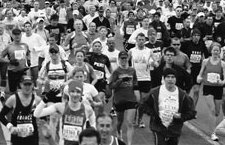
Last Saturday, I ran my first 1/2 Marathon.  My friends Chris King, Todd Barlow and I had been training for this race since July.  Three miles, then four…five miles, then six…seven miles, then eight…nine miles, then ten…and finally the day came for the Baton Rouge Beach (yes, I know, somewhat of an oxymoron) 1/2 Marathon and Marathon.  The race was scheduled to begin at 7 am sharp on Saturday, December 6th.   On Friday, I spent my day off getting ready for the race. I loaded my ipod with plenty of Bon Jovi, Boston and Journey, made sure my shoes, shorts and shirt were in proper condition.  It was supposed to be cold, so my gloves and cap would be essential, at least for a portion of the race.  The course ran right in front of my church, and by that time, I would be well warmed up and could easily discard my unneeded articles of clothing there.  I talked with both Chris and Todd.  We worked out our time and place to meet and spoke encouraging words to one another.  I went to bed excited and ready for the race. 

On Saturday, I got up early.  My wife and I still own our house in the country and we commute into Baton Rouge, so we had a bit of a drive before us.  She had graciously agreed to go with me to this race.   What we had not anticipated was the snow and ice that had fallen through the night.  We left the house at 5:05 a.m.  At 5:30 a.m.  we were sitting still on the Interstate, in along line of traffic.  The bridges had iced over and there had been numerous wrecks, so they had closed the Interstate while the wrecks were cleared and while trucks treated the bridges.  It became clear that I would not make it to our scheduled meeting time of 6:10 a.m.  and I feared I would not make it at all.  6:00 a.m., 6:30 a.m., 6:45 a.m., still sitting…still waiting.   The guys knew to start without me.   They thought I would just go back home and live to run another day.  But at 7:35 a.m.  traffic started moving.   By that time, I was fit to be tied.  Angry, disappointed, edgy, not good company, just ask my wife.  I wanted to go home.  But Julie had other ideas.  She looked at me and said, you trained for this race and you are going to run this race.  You may start late, you may finish late, but you are going to run this race. 

We arrived at 7:55 a.m.  I started the race at 8:01 a.m. and finished 2 hours and 28 minutes later, alone with my thoughts and accompanied by the sounds of Bon Jovi’s voice ringing in my ears.  About mile 7, the marathon runners began to lap me.  Their presence and their words of encouragement helped me along the way.  I was not alone on this journey, after all.   At mile 11, my left calf knotted up, the result of dehydration, but I kept plugging along.  I topped the Perkins Road Overpass not knowing if I could finish.  I hobbled down the bridge and realized that I was on the home stretch.  I had a renewed sense of energy with the end in sight.  I made up my mind then and there I was going to finish.  I began to pick up the pace, running through the pain, trusting my mind to win out over my pain, and I made my way onto Lakeshore Drive.  This was familiar territory.  I had spent many afternoons and evenings running this route.  Mile 12.  1 mile left.  The finish line in sight.   As I approached the finish line, with just over 1/2 mile to go, my ipod shuffled to the next song and the words rang in my ears like the sounds of church bells ringing at noon on Sunday, Ohhhh Oh, you’re half way there, Ohhhh Oh, livin’ on a prayer.  Take my hand and you’ll make it I swear, Ohhh Oh, livin’ on a prayer.   My stride lengthened and my pace quickened.  I began to cry, not expecting such emotion, and I crossed the finish line, feeling more alive than I had in a long time. 

Reflecting on this experience, I’m not sure what the race would have been like for me had I started on time and finished with my friends.  I hope to have that experience when I run my next race.  But I do know that having to wait so long, realizing that things would not turn out as I had hoped, being forced to face my own fears and frustrations, my own anger and disappointment, caused this race to be more than just a race for me.  It was truly a refining  and purifying process.  The race cleansed my heart and my soul, not to mention my body.  I was reminded with each step and stride that the race is not just for the swift and strong, but also for those who endure it to the end.  

As our Advent journey continues, may we wait with more patience, hope with more fervency, pray with more consistency and run the race with more patience, one step at a time, facing the pain, persevering through the suffering, allowing our anger and frustration to be cleansed and purged, remembering along the way that we are never alone, trusting in the God who come to us and calls to us in Christ.  

Venite adoramus!

A Communion Meditation

Dining in the Shadow of the Dogwood Tree

This is an expansion and adaptation of a previous post. VAS

In a family gravesite in Mississippi, I have my own little communion of saints.  Not saints in the sense of perfect people who all got it right and did it all the right way, but saints in the sense of having made it home, having completed their course and now rest from their labors.  Most prominent for me is my father, a good man and an even better father who made a significant down-payment on my future in my four short years with him. He died far too young.  But he lives on in memory and story and in the two sons he claimed and did his best to “raise right” in the short time he had.  Each year I give special thanks for him and for all those who, in spite of their imperfections and shortcomings, their trials and tribulations, are, for me, saints nonetheless.  

There also are my maternal grandfather and grandmother.  They were dead long before I was born.  I was named after him and I have been told that she was the glue that kept the family together during the depression, working at the cotton mill and keeping watch over a household that included two small girls, my mother and my aunt, an invalid mother, my great grandmother, and two of her sisters who occasionally lived with them – Sally, my great-aunt, who married Pete, an enlisted airman and moved to St. Louis.  They travelled the country and had pictures to prove it, but eventually divorced and she moved back.  She smoked far too much and died of lung cancer and is buried in the family grave.  And then there is Maggie, the great-aunt who lived her life in the spirit of Mae West who always said, “When I’m good, I’m very good, but when I’m bad, I’m better!”   Aunt Maggie was a tall woman with beautiful red hair, a salty vocabulary and a questionable reputation who lived to be almost 90.  She often told stories of her glory days owning a restaurant with her first husband that included elaborate descriptions of colorful characters who found their way to The Sunset on Highway 51.   What she never included though, was any mention of running moonshine which was, I have been told,  the real reason so many colorful people frequented this establishment.   Later in life, she married a cop and moved to Louisiana.  Talk about a change of heart.  She made great gumbo and amazing spaghetti and meatballs. She was by no means perfect, but part of the communion and fellowship, nonetheless.  

It is a small group, a snapshot of history and heritage, both good and bad, the fabric of my life.  Every year I reflect on this colorful communion of saints that in ways both great and small shaped my life.  Who are the saints in your communion? Those you are glad are there and those you wish were not.  Who have been the people who have shaped your life in meaningful ways? Who have been those who have formed you by teaching you how not to live? Take the time to remember them and offer a prayer of thanks for them all, even the ones who barely made it in.  They are a part of the communion as well.

Standing watch close by my family gravesite is a dogwood tree.  As a child this tree was a special friend, a playmate of sorts, for in the months immediately after the death of my father, my mother, my brother and I spent many afternoons there.  She would go there to sit for a while, a young wife mourning the loss of her husband and we would climb in the crooks of the dogwood tree and swing from its branches.   Some days, as the sun would make its way toward the western horizon, the dogwood would cast a long shadow and gently caress the tombstones with its touch, and there, in the shadow of the dogwood, in the midst of a microcosm of the communion of saints, two small boys hungry from climbing would kneel at the feet of their mother and share a sacramental meal of peanut butter crackers and coke.

There is a legend that at the time of crucifixion the dogwood had been the size of the oak and other forest trees. So firm and strong was the tree that it was chosen as the timber for the cross. To be used thus for such a cruel purpose greatly distressed the tree, and Jesus nailed upon it, sensed this. With compassion he said to the tree:

“Because of your regret and pity for my suffering, never again shall the dogwood tree grow large enough to be used as a cross. Henceforth it shall be slender and bent and twisted and its blossoms shall be in the form of a cross–two long and two short petals. And in the center of the outer edge of each petal there will be nail prints, brown with rust and stained with red, and in the center of the flower will be a crown of thorns, and all who see it will remember.” [1]

On this day of remembrance, we gather to dine once again in the shadow of the dogwood tree, to share in a sacramental meal, remembering those who have gone before us, looking to those who surround us still, giving thanks for those who have nurtured us, forgiving those who have failed us and feeding on that which alone can ultimately save us. 

So come, climb once again into the arms of grace and swing once again from the branches of God’s sustaining power and presence.  Kneel at the foot of the cross…remember…give thanks…and be filled.

In the name of the Father, Son and Holy Spirit.  Amen.


[1] http://www.promiseofgod.com/dogwood/

Justifying the Cost


In the heart of Gary, Indiana, there stands a decaying monument once dedicated to the glory of God.   The towering, gothic City Methodist Church opened its doors in 1926.  In its day it was the social and cultural hub of the city, with its large church hall hosting plays, musicals and pageants open to all city residents. 

The church was built as a symbol of decency in the heart of a rowdy, irreligious Gary that was less than 20 years old. 


The congregation peaked at around 2,000 members during the 1950s, but by the 1970s, City Methodist had fewer than 200 members, and offerings weren’t enough to even pay the utility bills, much less repair the antique organ, leaking roof and failing boilers. Church leaders attempted to find a congregation interested in the structure, but no group wanted to take on the expense of maintaining the enormous church. 

According to Andy Grimm of the Post Tribune, these days “pigeons and stray dogs take shelter within the church. The lone improvement since the 1970s came a few years ago, when the city, which now owns the property, installed a barbed wire fence around the building.”     

Across 6th Street from City Methodist, Gary Housing Authority has begun a $14 million housing development.  Joseph Shuldiner, one of their consultants, is quoted as having said, “We’re building new housing and … having a vacant abandoned building is not conducive to marketing. Rehabilitating the church would take millions.   

“I can’t think of a use for it that would justify the cost.”

A bit warmer...

These days, two of the most pressing questions for us all to answer are:

“Does our church’s mission to make disciples of Christ for the transformation of the world justify the cost?” 

“What will it take for us to commit ourselves to the task of serving this present age with faithfulness and relevance?”

Much Good Work to Do


In thinking about stewardship, I have been drawn recently to the writing of Wendell Berry.  In his 1992 book, Conservation is Good Work, he wrote,
“No settled family or community has ever called its home place an “environment.” None has ever called its feeling for its home place “biocentric” or “anthropocentric.” None has ever thought of its connection to its home place as “ecological,” deep or shallow. The concepts and insights of the ecologists are of great usefulness in our predicament, and we can hardly escape the need to speak of “ecology” and “ecosystems.” But the terms themselves are culturally sterile. They come from the juiceless, abstract intellectuality of the universities which was invented to disconnect, displace, and disembody the mind. The real names of the environment are the names of rivers and river valleys; creeks, ridges, and mountains; towns and cities; lakes, woodlands, lanes roads, creatures, and people.

And the real name of our connection to this everywhere different and differently named earth is “work.” We are connected by work even to the places where we don’t work, for all places are connected; it is clear by now that we cannot exempt one place from our ruin of another. The name of our proper connection to the earth is “good work,” for good work involves much giving of honor. It honors the source of its materials; it honors the place where it is done; it honors the art by which it is done; it honors the thing that it makes and the user of the made thing. Good work is always modestly scaled, for it cannot ignore either the nature of individual places or the differences between places, and it always involves a sort of religious humility, for not everything is known. Good work can be defined only in particularity, for it must be defined a little differently for every one of the places and every one of the workers on the earth…there is much good work to be done by every one of us and that we must begin to do it.”

In thinking about Berry’s words in relation the work of the church, there is also much good work to do.  We are stewards of the earth and all its resources.  We are stewards of the many gifts we have received.  We are stewards of the mysteries of God, keepers of the sacred traditions and rituals that have sustained people of faith for generations.  Faithful stewardship begins with each of us committing ourselves to the high calling of giving to something greater and believing that in doing so, good things can happen.  How can we all become more faithful stewards of the many resources we have been given to care for the earth which it the Lord’s as well as all that is within it?   What good work is God calling you to do?

The Spirituality of Serendipity

Serendipity is usually defined as unexpectedly discovering something fortunate or helpful, especially when looking for or expecting something entirely unrelated.

On Tuesday, I received a letter in my mailbox addressed to “My Friends at U.U.M.C” The return address read, Mr. Curtis Lilly T.U. Lower “B”/ #3 L.S.P Angola, LA 70712. I had received many such letters before. My initial assumption was that this was another request for money, advocacy or some form of assistance. And to be completely honest, there was a part of me that just knew I had intercepted a scam letter seeking to fleece the church with another stock sad story. What could we possibly do to assist anyone in Angola? But when I opened the letter and began to read, I was both embarrassed by my assumptions and disturbed by my cynicism. Mr. Lilly wrote,

Greetings: to the current pastor and entire congregation of the UUMC…, Dear Pastor, just wanted to say hello to my friends at UUMC, with assistant pastor Mr. Matt Rawle, (Matt is a former youth director who now serves on the pastoral staff at Broadmoor United Methodist Church in Shreveport, LA) who was such a blessing to me in the past, with house repairs (through) the youth group’s Habitat for Humanities. Even though I have been away for several years, I still have love for God and the church. As the holiday season rolls around I am reminded to be thankful for the gift of life and all of my fellow Christians at the church.

Talk about a serendipitous moment. Here I was ready to uncover a shakedown in progress and instead, it was as if an angel delivered a message straight from God. The letter continued,

This church has special purpose and meaning, and I would love to hear from you all from time to time. (Happy Thanksgiving) Your friend in Christ, C.M. Lilly. P.S. Please keep me in prayer this holiday.

I will keep Mr. Lilly in my prayers this holiday season.  I have also written him a letter thanking him for his words about the church I am privileged to serve.  But more than that, I have made a commitment to myself to fight the cynicism that is so widespread in our world today.  From tea parties to town hall meetings, cynicism abounds.  Institutions that serve the public good, whether they be governmental, religious or educational are looked upon more and more with disdain and distrust.   Programs that serve the common good, promote the betterment of the many and not just the few, strengthen support for the most victimized and vulnerable are now seen as a part of some sinister socialist agenda.  And far too many of us are simply too cynical and too unengaged.    Our obsession with how we think things are or should be can cause us to miss an opportunity to see how things really are or really should be.

Serendipity…discovering the holy in unexpected places…Serendipity…hearing the gospel from unexpected people…Serendipity…aha! moments that help us see things from a different perspective.  

I believe that serendipity can be cultivated. 

Stop turning a blind eye or a deaf ear the unexpected.  

Cultivate the art of expecting the unexpected.   

Doing so nurtures the spirituality of serendipity. 

Doing so opens us to the possibility of being transformed.

A Colorful Communion of Saints

There is a line in the wonderful hymn by Ralph Vaughn Williams, For All the Saints, that goes:

O blest communion, fellowship divine! 

We feebly struggle, they in glory shine;

All are one in Thee, for all are Thine.

Alleluia, Alleluia!

In a family gravesite in Mississippi, I have my own little communion of saints.  Not saints in the sense of perfect people who all got it right and did it all the right way, but saints in the sense of having made it home, having completed their course and now rest from their labors.  Most prominent for me is my father, a good man and an even better father who made a significant down-payment on my future in my four short years with him. He died far too young.  But he lives on in memory and story and in the two sons he claimed and did his best to “raise right” in the short time he had.  Each year I give special thanks for him and for all those who, in spite of their imperfections and shortcomings, their trials and tribulations, are, for me, saints nonetheless.   I recall my maternal grandfather and grandmother, Van and Grace Boutwell.  They were dead long before I was born.  I was named after him and I have been told that she was the glue that kept the family together during the depression, working at the cotton mill and keeping watch over a household that included an invalid grandmother and two small girls, my mother and my aunt, along with two of her sisters who occasionally lived with them. There was Sally, my great-aunt, who married Pete, an enlisted airman and moved to St. Louis.  They travelled the country and have pictures to prove it, but eventually divorced and she moved back.  She died of lung cancer and is buried in the family grave.  And then there is Maggie, the great-aunt who lived her life in the spirit of Mae West who always said, “When I’m good, I’m very good, but when I’m bad, I’m better!”   Aunt Maggie was a tall woman with beautiful red hair, a salty vocabulary and a questionable reputation who lived well into her 80’s.  She often told stories of her glory days owning a restaurant with her first husband during World War II.  She relished in describing the colorful characters who found their way to The Sunset on Highway 51.   What she never owned up to though, was running moonshine during the days of prohibition which was, I have been told,  the real reason so many colorful people frequented this establishment.   Later in life, she married a cop and moved to Louisiana.  Talk about a change of heart.  She made great gumbo and amazing spaghetti and meatballs.  Perfect by no means, but part of the communion and fellowship, nonetheless.  It is a small group, a shapshot of history and heritage, both good and bad, the fabric of my life.  Every year I reflect on this colorful communion of saints that in ways both great and small shaped my life.  And I say a prayer of thanks for them all.  

Who are the saints in your communion? Those you are glad are there and those you wish were not.   Who have been the people who have shaped your life in meaningful ways? Who have been those who have formed you by teaching you how not to live?  Take the time to remember them and offer a prayer of thanks for them all, even the ones who barely made it in.  They are a part of the communion as well.